

I’ve been at South by Southwest the past few days, and AI is everywhere. At every panel, every happy hour, every presentation, someone recommends the best way to optimize with your new AI agent. Specifically, if you work in marketing or advertising and aren’t AI-savvy today, you’re 2 years behind. Maybe 3.
That might be right, but the conversation probably doesn’t need to be so breathlessly dumb or dire.
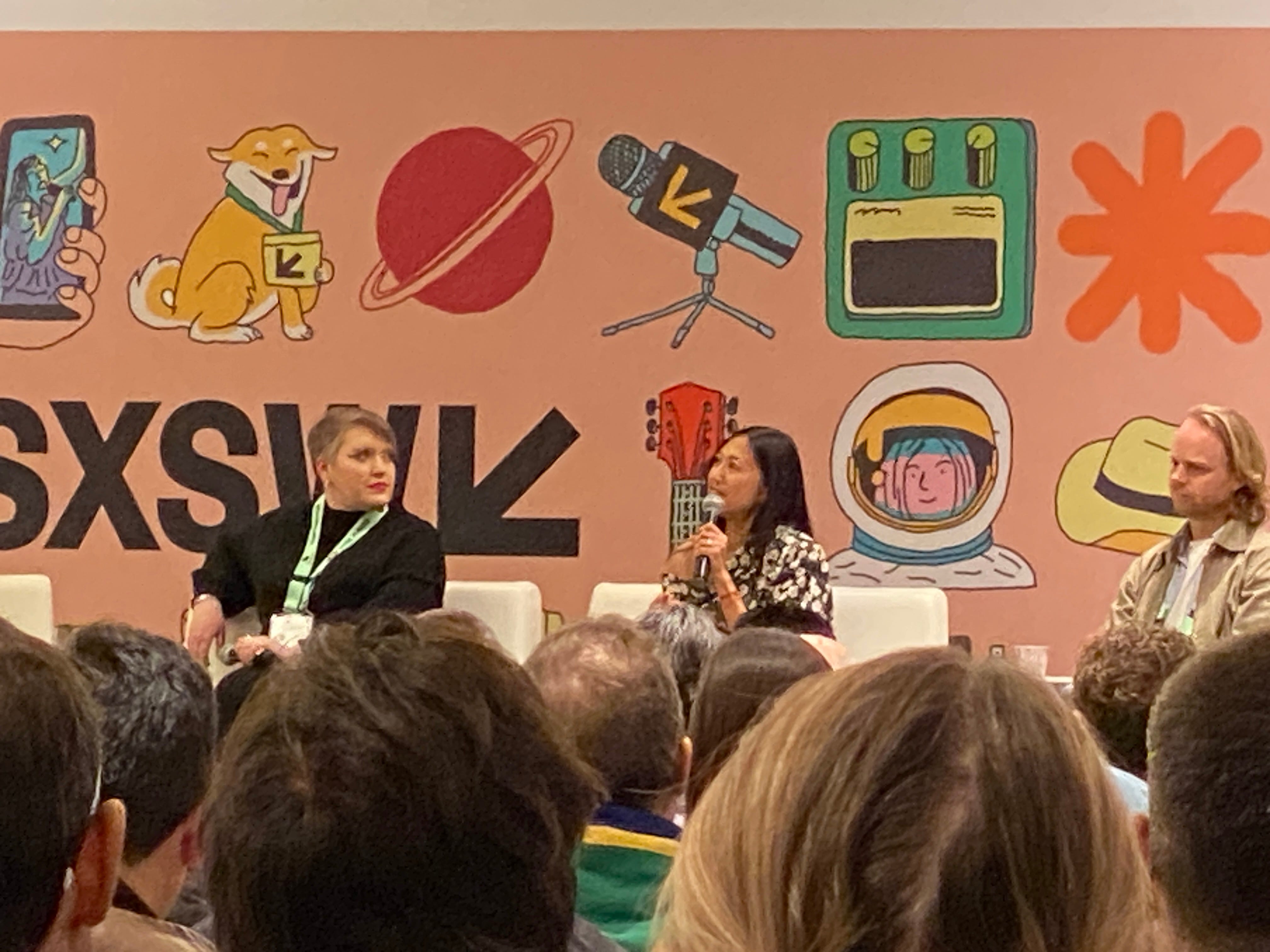
Grace Kao, the CMO at Snapchat (she’s in the middle), said something during a panel that I really liked. She was talking about CGI and how it’s evolved dramatically over the past couple of decades, with the tools getting better, cheaper, and faster. And then she said: “But without a good story, your movie is still bad.”
I think that’s really the entire argument here. (Totally fine to stop reading at this point.)
But she kept going, and it was worth hearing. AI can help you scale. It can help you brainstorm. It can help you mock up and generate. But at the center of everything, there has to be a strong concept. A strong story. People so appreciate craft. They also appreciate a really cool concept, and those two things are not the same as a really cool output.
Think about Moonlight. That was a film made for $1.5 million, with virtually no visual effects and no spectacle. Just light and quiet and the weight of a person trying to exist inside a life that keeps pressing in on them. Every frame of that film is handmade. The storytelling does all the work. The craft is in what gets left out, what gets held back, what never gets said out loud, which is why it won Best Picture over a $20 million musical.
Now think about Mad Max: Fury Road. That movie is wall-too-wall mayhem. Practical effects and CGI all woven together to create a spectacle, and it works because underneath all of it, there’s a simple story about freedom and who gets to have it. Strip away every explosion, and you’ve still got something that’s still compelling.
Both of those films work from a storytelling standpoint. One barely touches the CGI tools. One uses every tool at its disposal.
Here’s what I keep thinking about, though, and it has less to do with advertising and more to do with being a person on the internet in the year 2026:
People, on a primal level, want to connect with other people. They want to see other people. They want to emotionally understand other people. Why they think the way they do, why they feel what they feel. That’s what (I think) it means to be a person living in real life.
I know that when I read a piece of text now, I’m looking for AI. Are there too many em dashes? Is there that weird frictionless way of writing? The way a sentence can say a lot without saying a damn thing. I want to find the AI-generated text, and I don’t think I’m alone in that. I think we’ve all become amateur forensic linguists, hunting for anything that feels even a little bit off.
Part of what makes LLM-generated content feel weird is that it’s an aggregate. It’s trained on everything, so it sounds hollow; it sounds like a little bit of nothing. The sum of so many parts, smoothed into something that’s just slightly bland. It can sound beautiful, but there just aren’t any flaws. It hasn’t lived a real life, but it’s pretending like it has. It hasn’t lost anything, it hasn’t been embarrassed, it hasn’t sat in a parking lot at 2 am, making a decision that it’ll definitely regret.
I think we can see it. And I get why people want to hunt down the imposter and tell it to get the fuck out of here. People want something real. They want to read something that’s dripping with actual human stakes, with the mess and the nerve and the specific, irreplaceable weirdness of a person.
AI is coming for your throat. That part’s true. The tools are real, they’re fast, and they’re going to keep getting better. But the thing the tools can’t manufacture is the reason anyone should care. The story and the flaws that make it actually connect with other humans.
That part’s still yours. And I think, it always will be.
If you’re new here, I write a monthly serialized novel called Everything is Advertising, about a burned-out Creative Director and his cynical team that accidentally create QAnon through a viral marketing campaign. If you like that kind of thing, you can start at Part One and catch up from there.
Every Monday, Below the Fold talks through the stories behind the brands.
Every Friday, The Business of Advertising shares lessons from over a decade working on the front lines of advertising.
Mom, I'm scared. Can you come pick me up?
Really love this. We will always need the storytellers.