

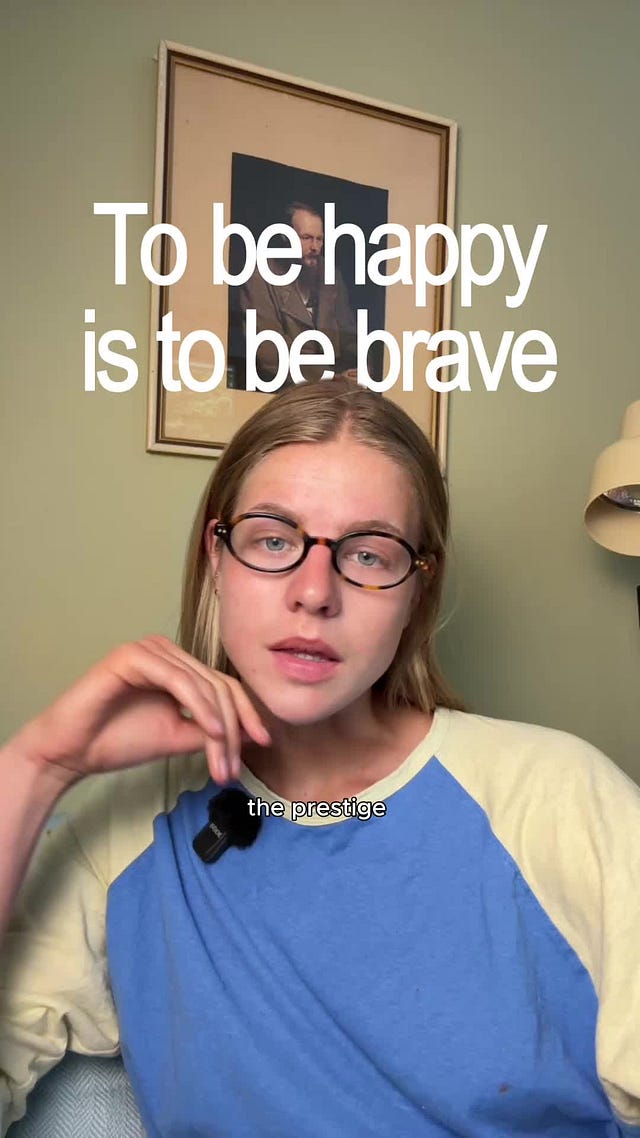
I love Vår’s content on TikTok, and would recommend it as necessary viewing for anyone exploring the platform. I really loved this video from her talking about how happiness is embarrassing:
 Tiktok failed to load.
Enable 3rd party cookies or use another browser
“The prestige of being unhappy runs so deep that we protest when someone calls us happy,” she says. “Being a bit miserable is understood to mean that you have a certain depth, while being happy means you haven't really looked around.”
In 1979, two psychologists, Lauren Alloy and Lyn Abramson, published a study called “Judgment of Contingency in Depressed and Nondepressed Students: Sadder but Wiser? (Here’s the paper on PubMed if you’re really curious: LINK) They had participants press a button and observe how often a green light turned on. The actual control the button had over the light varied. What they found was that non-depressed people consistently overestimated their control. They believed they were making the light turn on, even when they weren’t. Depressed people gave estimates closer to reality.
This paper has been cited many, many times since its publication and helped coin the term “sadder but wiser.” It became this shorthand for the idea that if you seem too cheerful, you aren’t paying attention.
In 2012, a meta-analysis by Moore and Fresco looked at 75 studies over 7,000 participants and found that the depressive realism effect was negligible, that both groups actually showed a positive bias in the light test. In 2022, Amelia Dev and Don Moore attempted to recreate the light experiment at UC Berkeley and found no evidence that depressive symptoms relate to perceived control (not in any way). Sadder wasn’t wiser, it was just simply sadder.
But the original idea stuck and still hangs around today.
Creative departments run on a specific, odd, misery-is-one-of-your-credentials style system. The most respected person in the room is usually the most tired, the most overworked, the one who has seen it all. The person who sighs when someone pitches something ambitious because they know that concept will slowly be ground down into a shell of itself.
If you’ve worked for an agency, you know these rules. Don’t be the person who gets excited about the brief or says “I love this” in a review. Don’t care too visibly about a project that may or may not be killed. The only approved emotion is exhaustion, having a been-there-seen-it-all energy that signals your aloofness.
That sounds like a lot of performing for the sake of it, so let’s circle back to Vår: “Unhappiness ends up not only feeling safe, but also respectable. A simple joy feels risky, almost embarrassing.”
The person who gets visibly excited about an idea in a review is taking a risk the cynical person never has to take. If the excited person’s idea gets killed, they look naive. Cynicism is a free pass, but enthusiasm has a cost.
Alloy and Abramson’s “sadder but wiser” hypothesis confirmed a bias that existed long before they ran their experiment, that misery means depth, and happiness means you missed something.
Now, to clarify, nobody wants a creative director who claps at every concept like it’s a kindergarten recital, or praises every line of copy like gospel. But, I do think the industry has gotten comfortable with treating cynicism as intelligence, and that ends up hurting everyone.
Being excited about a concept or idea is not a sign that you don’t understand the business. I would argue that being too jaded actually means you don’t understand the creative business.
Xx, Caitlin
L B Alloy, L Y Abramson, Judgment of contingency in depressed and nondepressed students: sadder but wiser?, 1979
Amelia S. Dev,Don A. Moore, Sheri L. Johnson, Karin T. Garrett, Sadder ≠ Wiser: Depressive Realism Is Not Robust to Replication, 2022
If you’re new here, I write a monthly serialized novel called Everything is Advertising, about a burned-out Creative Director and his cynical team that accidentally create QAnon through a viral marketing campaign. If you like that kind of thing, you can start at Part One and catch up from there.
Every Monday, Below the Fold talks through the stories behind the brands.
Every Friday, The Business of Advertising shares lessons from over a decade working on the front lines of advertising.