

Stick with me, I will make a point (I promise).
Means Workwear posed this trick question. “Should murderers go to jail?” It’s not a real question. It’s only posed as one, and it's what’s called discursive disclosure.
Discursive disclosure was coined by communication theroist Stanley Deetz to describe how institutions suppress conflict without people realizing they’re being suppressed. You’re not censored outright, instead you’re asked a question that contains the acceptable answer inside of it. Answer anything outside of what is deemed acceptable, and you’ll be seen as hostile or strange.
For example, if you ask someone: “Should murderers go to jail?”
The socially acceptable answer is: yes. But it’s deeper than that.
In Means Workwear’s words, baked into the question “should murderers go to jail” is a whole chain of assumptions. That punishment equals prison, that prison equals safety, that questioning any part of that chain means you don’t care about victims. That if you answer anything other than the expected yes, then before you can discuss anything about criminal justice reform, you’re first having to defend yourself against the implication that you’re pro-murder.
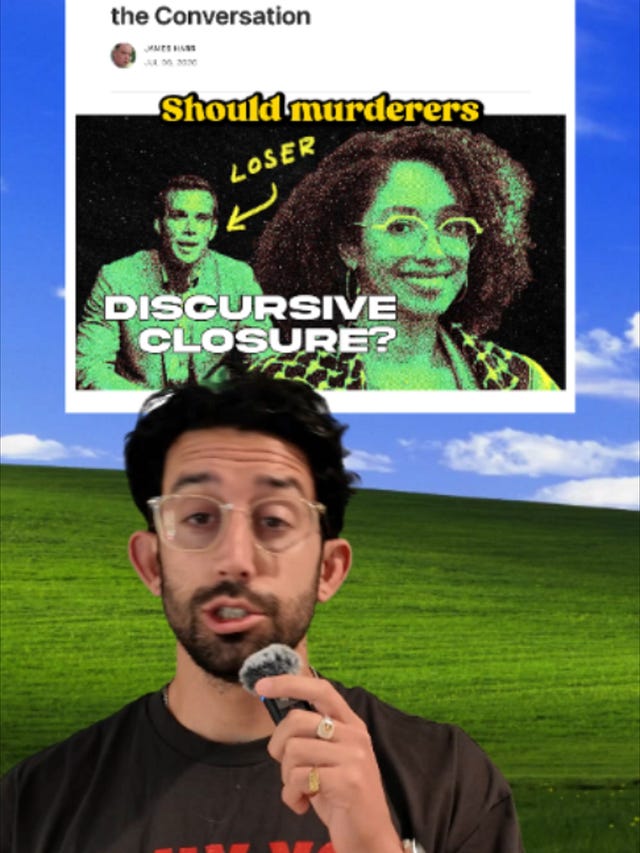
 Tiktok failed to load.
Enable 3rd party cookies or use another browser
What’s Your Biggest Weakness?
This dynamic probably sounds familiar to anyone who has sat in a conference room in a blazer that doesn’t fit quite right, answering questions about their personality and job history. In my view, a job interview runs on the exact same mechanics (it’s just aimed at your labor instead of your politics).
“Where do you see yourself in five years?” is not (even a little bit) asking about your five year plan. It’s asking about loyalty to a company. The honest answer for most people is something like “hopefully making more money, maybe somewhere else, who’s to say.” But you can’t say that. The right answer requires you to invent a future where this particular employer is the centerpiece of your life and ambitions.
“Why do you want to work here?” is the exact same thing. Everyone in the room knows the real answer is “because I need to pay rent.” Instead, you need to construct a narrative of specific enthusiasm for this company’s mission and goals.
And “what’s your biggest weakness” is the most open version of this trick. It’s compliance pretending to be vulnerability. You are asked to be self-aware while actually revealing nothing.
Now Back to Deetz
In Deetz’s original framing, discursive disclosure isn't an accident of bad communication, it’s a tool of organizational power. It lets an institution get compliance from people while those people believe they’re having a real conversation, making a real choice, or being genuinely evaluated.
A job interview markets itself as an assessment of your skills, but it’s more an assessment of your ability to understand the rules of engagement. Can you read the unstated rules fast enough to perform them convincingly? Can you package your actual, complicated relationship to work into the shape an interviewer is already looking for?
This isn’t (by the way) a call to blow up every interview by telling the truth about wanting a paycheck. Rent is due on the first, that’s just what it is. But, once you know the trap, you won't fall into it. A job interview is not a real assessment of your worth, and it never will be.
Walk into that conference room with the understanding of exactly what game is being played, and decide how much of your actual self you’re willing to trade for the job.
Xx, Caitlin.
If you’re new here, I write a monthly serialized novel called Everything is Advertising, about a burned-out Creative Director and his cynical team that accidentally create QAnon through a viral marketing campaign. If you like that kind of thing, you can start at Part One and catch up from there.
Every Monday, Below the Fold talks through the stories behind the brands.
Every Friday, The Business of Advertising shares lessons from over a decade working on the front lines of advertising.