

The apartment door flung open, and hallway light poured in. Marie’s studio apartment had learned the trick of looking big and spacious, but only when all the lights were turned off. With the flick of a dirty light switch, the truth of the very tiny space returned.
Laundry had snaked its way to every part of the floor. Shirts thrown into probably-worn, maybe-worn, and definitely-worn piles. Socks that had no hope of ever being pairs again. Suits filled with every wrinkle in the known universe.
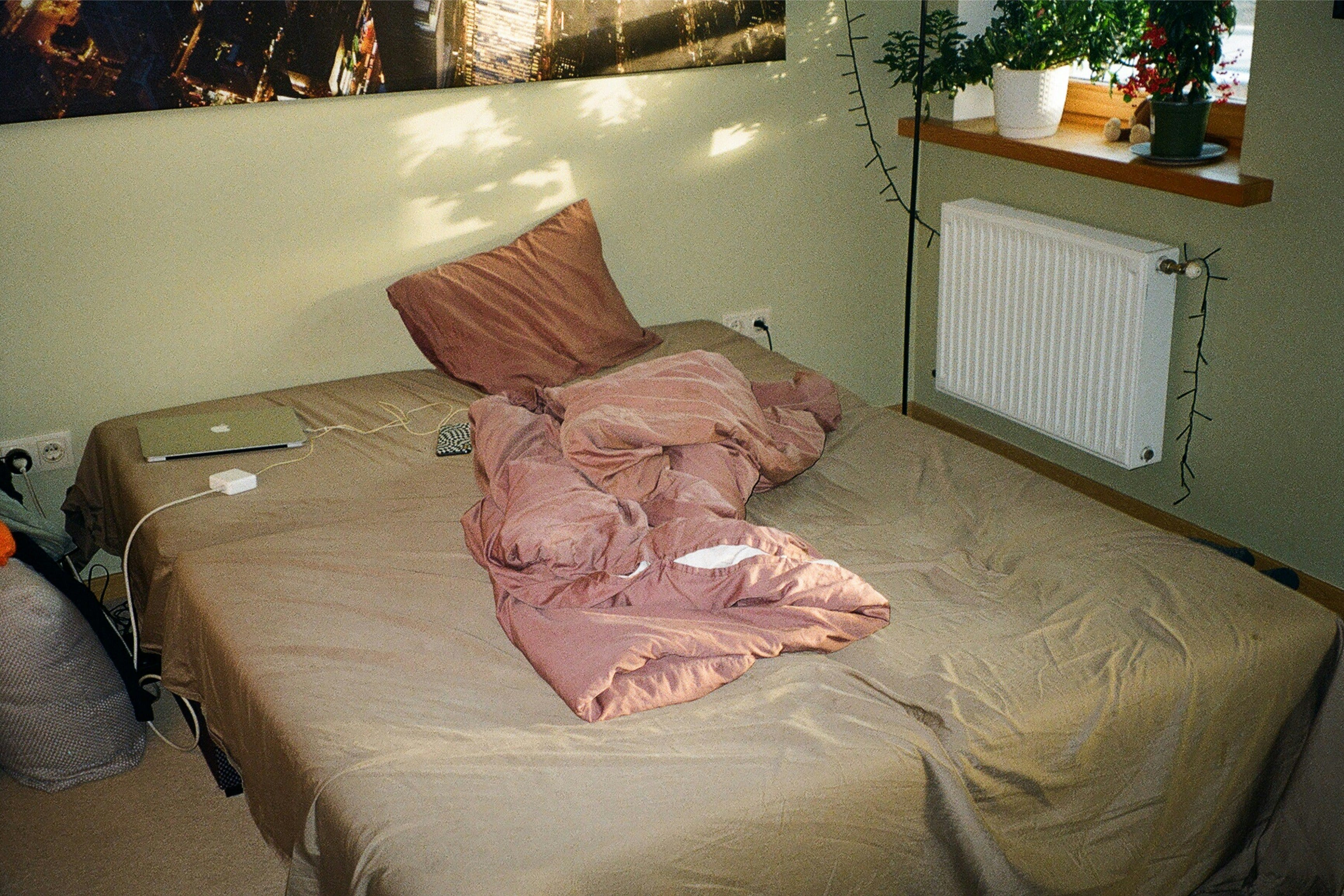
Her bedsheets were twisted into ropes, there were decorative pillows on the floor, and fun-size Milky Way wrappers dotted her dark comforter like little stars.
She tossed her tote bag to the floor in the middle of the chaos. The shoulders of her blazer slid off. Trousers unhooked, unzipped, the sudden cold of the room dusting her legs.
She stood in front her small ornate mirror that didn’t match anything else in the room. The gold frame gave her a little confession booth to share her sins. She had added the gold paint using a spray can and the dumpsters out front as a work surface. The landlord asked if she was the one who left the paint marks.
“Definitely not,” she told him.
She pressed a thumb under one eye, then the other, making the mascara smudge even smudge-ier. Not like she’d been crying, more like she was auditioning for some low-budget horror film where the ghost of pre-war studio apartments hadn’t slept in weeks.
On the windowsill, between the dying succulent and a stack of unopened mail, Marie kept her altar. She wasn’t religious or anything crazy like that, but she did collect little pieces of proof that she’d existed, in this moment, in this city. Proof that she was real.
A little matchbook from the bar two doors down. A plastic cup that had once held a tea light and now held bobby pins and a pen cap. One tall prayer candle in a glass sleeve, the kind you can buy at any bodega in New York on the bottom shelf next to the cat food. There was a MetroCard, the first one she got when she arrived in New York City. It was good luck, probably. And a takeout menu from a Chinese place she had never been, but planned to someday order from.
She would occasionally light the prayer candle. She loved how it looked against the backdrop of the lights in the building across the street. The Virgin Mary glued to the front cried a single tear. It looked a bit performative, but she was certain it came from a place of real sorrow.
She didn’t light it every day. That would imply routine and stability, or that she was a person with a five-year plan. She was, but if she thought too hard about the future and all the things she needed to do, it all became a little too much. More than anything, she lit it to nudge the universe in the right direction.
FLLLLLICK. The wick took a second to catch. A small flame trying to be brave in a city built to bully small things. Marie watched the light catch the glass, as it created a small, beautiful glow in her studio apartment. The room hadn’t changed, her day hadn’t changed, but the flame existed, and that was something.
Across the room, in the kitchen, the fridge buzzed. Inside, milk slowly aged into chunks, peaches grew themselves stylish green sweaters, and the jam just sorta sat there. Behind all of it, a large, lidded rectangle. The casserole. The thing brought by a well-meaning neighbor last week, after the fire alarm incident had woken her up at 4:30 am. The neighbor said she was cooking pierogies, but Marie suspected that might be code for meth.
She carefully slid the casserole out of the fridge, thunked it onto the counter, and popped the lid. One big, coagulated mass, with some elbow macaroni added for additional girth.
She forced open the drawer; a landlord special paint job ensured it always stuck, especially in the summer, grabbed a spoon, one of the large serving kind, and took a first, massive bite. It was ice cold, but kinda good. The second bite was mostly salt, in a definitely good way.
She slid down the cabinet until she was on the floor, knees up, casserole wedged between them. It looked like she was doing one of those old-fashioned exercises where you squeeze a hoop between your knees. The spoon clinked across the glass bottom as she consumed her power dinner.
In the wall to her left, filtered conversation came in and out like the Coney Island tide. The building didn’t believe in privacy. The walls were thin, and if you were going to have a fight with your wife, it was going to be everyone’s problem. Marie actually preferred it this way. Having other people’s lives as white noise meant hers could be static.
After consuming the casserole in the fashion of a slumped-over goblin, she dropped the spoon into the empty dish and crossed back over to the bed. En route, she flicked off the kitchen light, letting the space enlarge itself by the glow of a single candle.
She fell sideways onto the bed. Her phone, face down on the nightstand, buzzed to get her attention. She gave in easily and unlocked the screen with code 1234. A password someone would only dare use on their luggage.
Thumb, swipe, the little red cartoon flame opened with its subtle flicker animation. Tinder popped open, personal sales pitches immediately presenting themselves.
A man with a fish. You know the pose.
A man standing in front of the sign for Zion National Park. She had hung off the chains at Angel’s Landing, and it wasn’t a fond memory.
A man in a suit with a tie so red he could be a congressman. He checked both “Christian” and “conservative” on his profile.
Left, right, left. Muscle memory remembered her dating preferences without her. Anybody she paused on had the same face, all expressed in different places. Different universes. A baseball cap and a toddler, a freshly killed elk, a gym mirror selfie. Bios did their elevator pitches with varying degrees of grammar.
“Six four is it matters.” (It kinda mattered.)
“Looking for my partner in crime.” (Okay, Clyde.)
“No drama.” (Sure, Jan.)
Marie had always known that she didn’t really like Tinder, but she did like the feeling of choice at your fingertips. It felt like control. If she swiped enough, she could trick the rational part of her brain into thinking she had found real, human connection. It was so simple!
A siren a few streets over wailed for a while, then settled as the cops hopped out to harass a homeless man. Marie adjusted her pillows to start her true wind-down process for the night She tried a few positions, then surrendered to something that felt only slightly uncomfortable. She used a second pillow to rest her phone and scrolling arm.
Left, left, right. Him.
Joel’s face appeared on her screen. It wasn’t a professional LinkedIn headshot; it was a weird casual image in Central Park shot from a low angle, probably by his daughter. Gross. His profile was a mix of photos in band t-shirts, un-shavenness, and soft weekend light. The whole thing was jarring and a not-so-subtle attempt to make him look 10 years younger.
Hard pass. Left swipe. This had to be the end of it for tonight.
She had rules for situations like this, which meant that she held a collection of strong beliefs about herself. The stories she told herself about the kind of person she was. One of them was about not being the kind of woman who slept with someone at work. Another was about being the kind who refused loneliness and dressed up even if there was nowhere to go. The third was about not being predictable, not even to herself. The rules worked best when they weren’t tested.
Her phone lay there now, face down, still buzzing for attention. Twice. A third time. Apps needing inputs now. A human, a robot pretending to be a human, a robot pretending its name is Steve from Verizon. She didn’t check.
In the wall, the conversation next door heated up: “WHO THE FUCK IS JESSICA!?” Then resolved itself. Must have been a family friend, or an elderly coworker. The fridge made that weird reset sound, and somewhere in the building a toilet flush really made a show of it.
On the windowsill, the prayer candle threw a thin layer of light onto a stack of mail as if it were casting a blessing onto her overdue water bill. Marie let her hand rest on her stomach and felt the solid, heavy casserole. She rolled over and closed her eyes. When you stand on the edge of a cliff...
If you’re new here, I write a monthly serialized novel called Everything is Advertising, about a burned-out Creative Director and his cynical team that accidentally create QAnon through a viral marketing campaign. If you like that kind of thing, you can start at Part One and catch up from there.
Every Monday, Below the Fold talks through the stories behind the brands.
Every Friday, The Business of Advertising shares lessons from over a decade working on the front lines of advertising.
lol.