

Vogue Adria’s May 2026 issue features Slovenian philosopher Slavoj Žižek on the cover, shot by Juergen Teller. The cover image is him looking through a hole in a wall. The interior spread is a series of him standing in various locations around Slovenia’s capital city, very much not enjoying it. In one shot he’s in front of a wall graffitied with the word SUCKERS.
He is wearing his own clothes. There are no fashion credits. MORE.
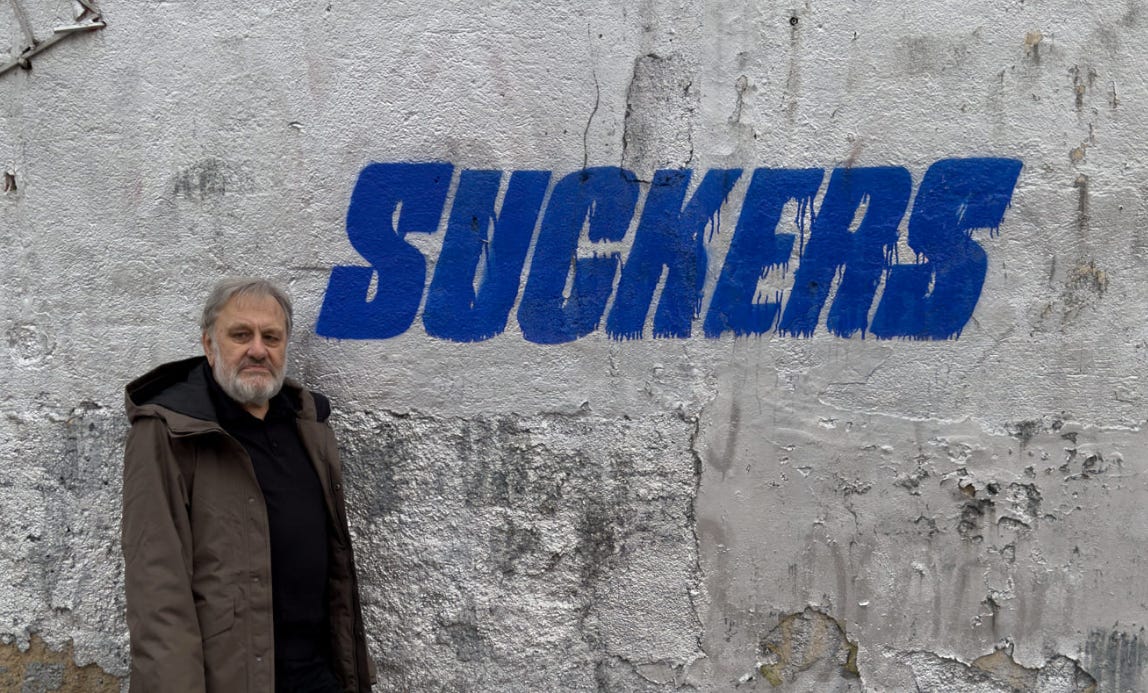
Image credit: Jurgen Teller
To understand what the hell is going on here, we have to understand Žižek.
Let’s start with Karl Marx: Marx believed that people go along with systems that exploit them because they've been tricked. They don't see what's really happening. The capitalist tells you the wage is fair and you believe him. The priest tells you suffering is noble and you believe him. Lift the veil, show people the truth, and they'll revolt.
Žižek’s career has been focused on flipping that idea: He says no, people aren't fooled. People know perfectly well that the wage isn't fair, that the ad is manipulating them, that the influencer was paid, that the politician is lying. They participate anyway. A cynical distance doesn't free you from the system, it lets the system keep running. "I know it's bullshit, but I'm doing it anyway" is not resistance, it’s compliance.
Žižek is really useful for thinking about advertising. The old worry was "people are being brainwashed by ads." Žižek says "people know they're being sold to, they make jokes about being sold to, and they buy the thing anyway, and that's worse."
He talks a lot about Coca-Cola, saying that the brand markets itself as special and necessary, but will never actually do what it promises (quench your thirst). That’s his point about a perfect commodity, that satisfaction isn’t the point, that your desire is. If you drink a Coca-Cola, you want another Coca-Cola. If you buy something, you want another of that something, you are now in a loop that will not end.
So Why Did Vogue Put Žižek on It’s Cover?
I think there’s a few things happening here. Žižek built his career on the idea that capitalism survives by absorbing its critics. He’s now on a Vogue cover getting photographed in front of a wall that calls the audience suckers, and tells the interviewer he calls himself a “moderately conservative communist.” It’s almost too spot on. The system takes a guy who criticizes the system, puts him on a Vogue cover, and sells him back to us.
Initially, I thought this was the point. …But maybe that’s not the point?
(lol, I promise I’m building to an actual point here)
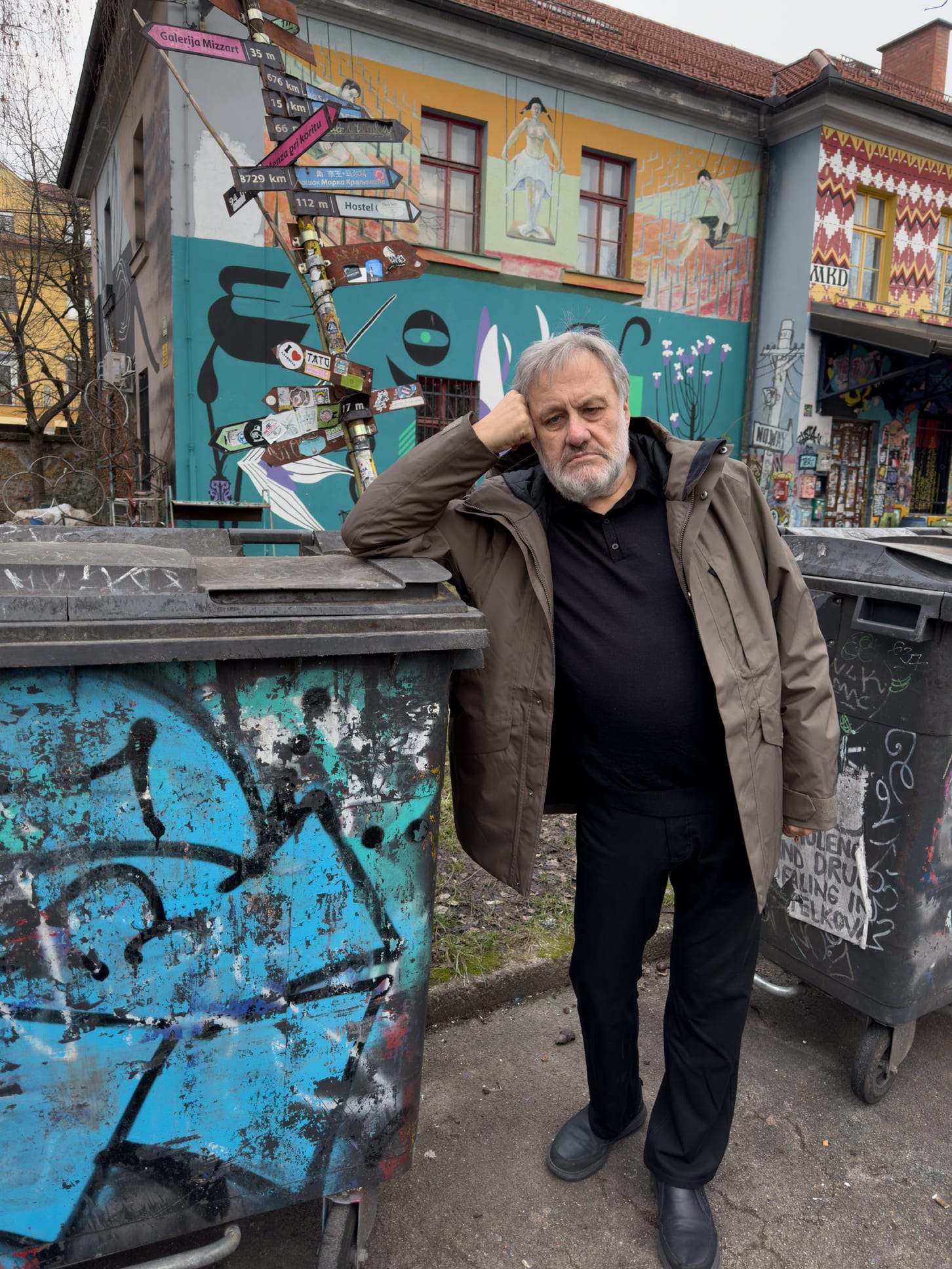
Image credit: Jurgen Teller
He’s not styled, the poses are bad (maybe on purpose), the locations are weird. It’s all a bit jarring. Photographer Jurgen Teller has spent 30 years making fashion look awkward and exposed, and he’s using that whole skill set here. Vogue Adria isn’t trying to make Žižek fashionable. Vogue Adria is making his refusal to become fashionable into a fashion story.
The interview (I think) supports this interpretation. Žižek didn’t want to do the interview or the shoot. He told the writer, Teodora Jeremić, that he had already said everything he had to say in his books. He spends the conversation on the things he actually cares about: that the liberal center is disappearing, that Trump is power’s “obscene dimension” made visible, that the left has lost the language of dignity, and that he was happiest during Covid because he didn’t have to see anyone. He says he likes being a passive smoker. He says he would prefer to live in Svalbard.
None of this is fashion writing. It’s a man being himself in a magazine that normally asks people to be a very polished, extreme version of themselves.
So then, who is laughing at who?

Image credit: Jurgen Teller
Žižek isn’t laughing at Vogue (I don’t think). Vogue Adria isn’t laughing at Žižek, they’re letting him be the version of himself that doesn’t (necessarily) sell magazines. Teller isn’t laughing at either of them, he’s doing what he always does. The reader is in there somewhere, possibly the sucker in the whole thing (maybe not).
The cover doesn’t resolve to a clean thesis. And maybe that’s the point.
Go back to the ice cold Coke. The perfect commodity doesn’t satisfy you. It produces more wanting. You drink it, you want another one. Žižek would say the Vogue cover is doing the same thing. You look at it and you don’t know what to think, so you look again. You read the interview, you text the link to a friend, you write a Substack post about it. The cover isn’t selling you Žižek. It’s selling you the experience of not being able to figure out what Vogue is doing. That experience doesn’t end. So you keep looking.
I think that’s my main takeaway as someone working in advertising. Most brand work tries to resolve. The manifesto resolves. The values statement resolves. The brand film about joy resolves. The form and the message are saying the same thing, you absorb it in three seconds, and then you’re done. The work satisfies you and you move on.
Vogue Adria made something that doesn’t satisfy. The cover is a man looking through a hole in a wall. The interview is a philosopher saying he wants to live in Svalbard. The styling is whatever he had on. None of it adds up to a clean message, which is why I really like it.
Žižek would say we already know we’re being sold something. We’re going to buy the issue anyway. Maybe that’s what makes it work.
Xx, Caitlin
If you’re new here, I write a monthly serialized novel called Everything is Advertising, about a burned-out Creative Director and his cynical team that accidentally create QAnon through a viral marketing campaign. If you like that kind of thing, you can start at Part One and catch up from there.
Every Monday, Below the Fold talks through the stories behind the brands.
Every Friday, The Business of Advertising shares lessons from over a decade working on the front lines of advertising.
I think Slavoj Žižek is playing a joke on Vogue here - it feels way too obvious to not be part of his work.
Wasn't expecting communist scholar analysis from you. I like it.