

On January 22, 2026, TikTok introduced its new US entity called TikTok USDS Joint Venture LLC. It was created so the app can keep operating in the US without tripping the 2024 divest-or-ban law.
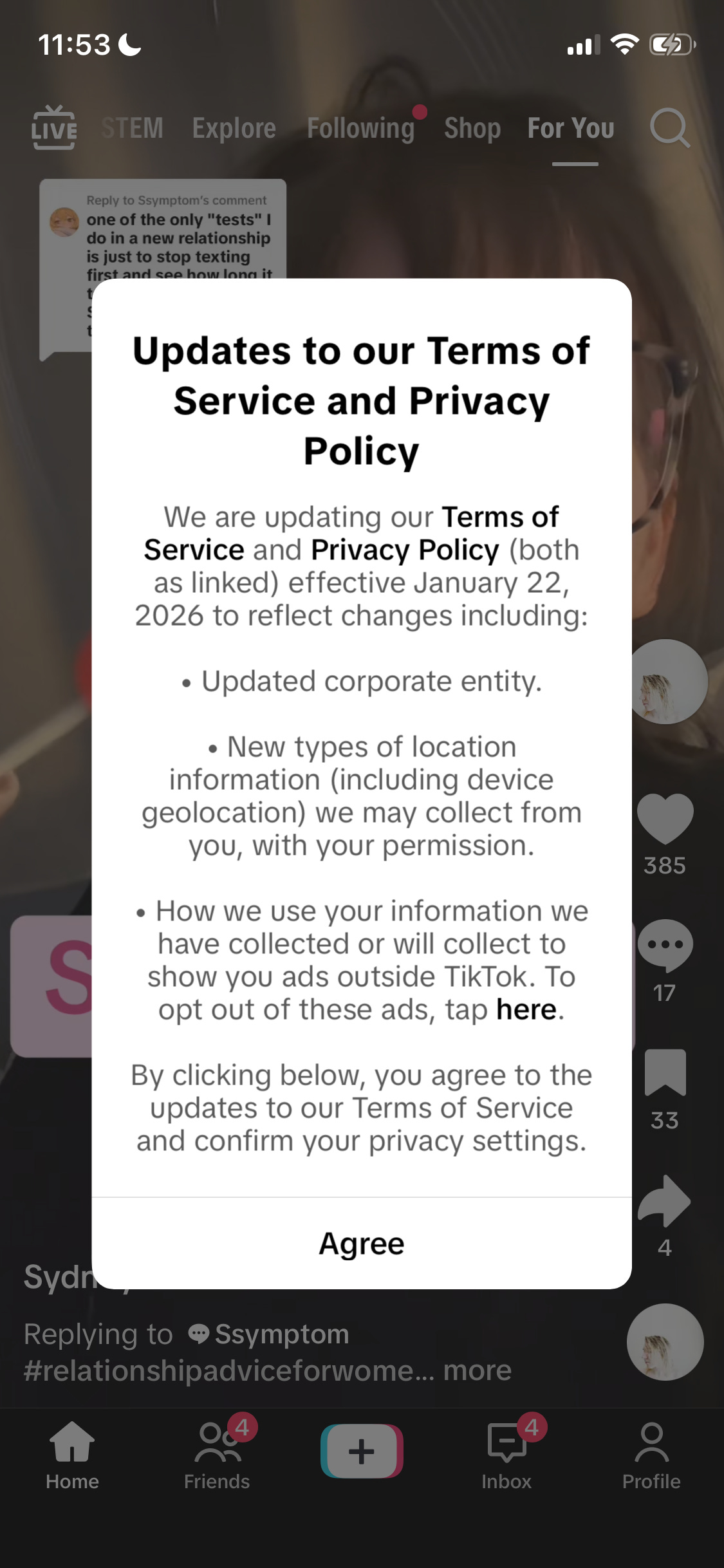
If you opened the app around the time of the deal closing, you likely got the pop-up below: “We updated our Terms/Privacy Policy.”
So… who “owns” TikTok in the U.S. now?
Many people and many companies. Under the new structure, ByteDance is down to 19.9% ownership, and the other 80.1% is held by a US-based investor group with Oracle, Silver Lake, and MGX as “managing investors,” each with 15% stakes.
TikTok has framed this as a data-security update with US user data housed on Oracle’s systems.
–-
Alongside the ownership change, TikTok pushed an updated privacy policy that adds precise location (at a GPS coordinates-level) if you allow the app to use your phone’s location services.
One Important nuance: TikTok is saying it can collect your coordinates when you give permission, and it can also infer less precise location through other means (like your IP address). TikTok’s own help page makes this explicit. You can turn off Location Services, but TikTok may still retain less specific location info previously inferred (like what city you live in).
So yes: the new language is a step toward more granular tracking, especially if you (or your phone) ever taps “Allow.”
–-
A lot of the collective panic this week has been fueled by one specific detail: the updated policy spells out categories of “sensitive information” TikTok could collect, including things like sexual orientation, transgender/nonbinary status, and citizenship/immigration status.
Some legal folks are saying the disclosure is, at least in part, compliance language (i.e., “we have to tell you what categories exist.”) But, even if it’s “just disclosure” it’s still disclosure of what the company is capable of tracking.
–-
But, who’s at risk when apps know exactly where you are?
Everyone. Precise location data can show where you live, where you work, who you spend time with, which clinics you visit, which protests you attend, which bar you went to last night, and whether you sleep at the same address every night.
Organizations like the Electronic Frontier Foundation have been flagging for years that location data can be sold and repurposed in ways users never intended.
To our immigrant community: Location data and data broker information has been used in ways that can support surveillance and enforcement, sometimes without warrants, sometimes through data purchases by agencies like ICE.
To our trans community: This data can expose routines and sensitive healthcare patterns, especially in an era where gender affirming care is politicized and scrutinized.
To our LGBTQ+ community: Geolocation can be weaponized; there are documented cases where location features have been used to entrap or target LGBTQ+ people.
To anyone who simply wants companies out of their personal business: You deserve privacy.
–-
So what can you actually do?
If you don’t want TikTok (or any downstream partner, or any government agency with access through legal process or the data economy) to know your location, the best move is to delete TikTok and its data.
Because “precise location” is only one pipeline. Apps can still infer a lot from IP, Wi-Fi networks, Bluetooth signals, device identifiers, and cross-app tracking ecosystems.
That said, if you’re staying on TikTok (no judgment, we all have our vices), here are the most meaningful settings to lock down your information:
If you’re on iPhone:
Settings >> Privacy & Security >> Location Services >> TikTok
Set Allow Location Access to Never (or While Using the App)
Toggle Precise Location OFF
If you’re on Android:
Pick whichever menu your phone has (both are standard Android paths):
Settings >> Location >> App location permissions >> TikTok >> Don’t allow
Two quick things:
Even with location permission off, TikTok can still infer approximate location (like city) from things like IP/network signals. TikTok notes this in their own explanation.
If you want zero location exposure from TikTok: delete the app and its data.
Want to know more about these updates:
If you’re new here, I write a monthly serialized novel called Everything is Advertising, about a burned-out Creative Director and his cynical team that accidentally create QAnon through a viral marketing campaign. If you like that kind of thing, you can start at Part One and catch up from there.
Every Monday, Below the Fold talks through the stories behind the brands.
Every Friday, The Business of Advertising shares lessons from over a decade working on the front lines of advertising.
I'm actually afraid of our government.